
Blog / Customer Experience
Customer Satisfaction Survey: Everything You Need to Know in 2026
Context
Learn everything about customer satisfaction surveys in this guide. Discover what CSAT is, how to calculate it, question templates, benchmarks, and best practices.
On this page
A customer satisfaction survey is how teams turn a recent experience into a clear signal: Was this good enough? What broke? What should we fix next?
In 2026 that signal matters more than vanity dashboards. The American Customer Satisfaction Index reported a national score of 76.7 out of 100 in Q1 2026, down slightly year over year and still stuck near levels last seen years earlier. Collecting a score is easy. Building a survey program that changes products, support, and retention is the harder job.
This guide covers the full loop: what a customer satisfaction survey is, how CSAT is calculated, when to use it (and when not to), question templates, channels, timing, interpretation, and how to close the loop. Pair it with 100 customer service survey questions when you need a larger question bank.
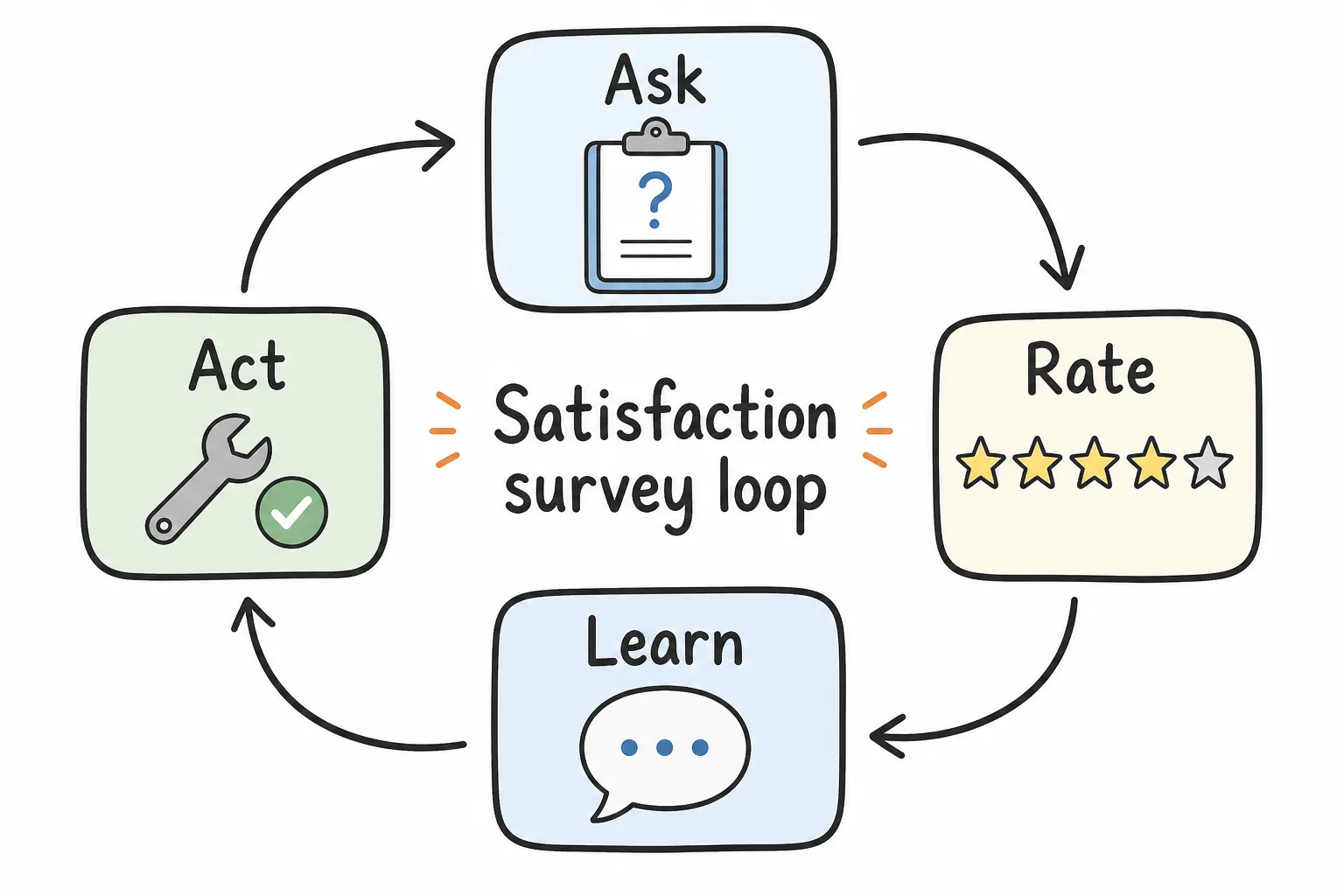
A useful CSAT program asks a clear question, captures context, and drives action.
What Is a Customer Satisfaction Survey?
A customer satisfaction survey is a short questionnaire that asks people how satisfied they were with a product, service, interaction, or overall relationship.
Most programs center on one rating question (the CSAT question), then optionally add:
- One “why” follow-up (open text or multiple choice)
- One attribute question (speed, clarity, resolution, value)
- Optional contact permission for follow-up
That is different from a long market-research questionnaire. Satisfaction surveys succeed when they are specific, recent, and actionable. If the answer cannot change a queue, a page, a policy, or a coaching note, cut the question.
Survey vs score vs index
Teams often mix three different ideas:
| Term | What it is | How you use it |
|---|---|---|
| Customer satisfaction survey | The questionnaire you send | Collect feedback at a chosen moment |
| CSAT score | % of positive ratings on your scale | Track a touchpoint or team over time |
| ACSI-style index | A modeled 0–100 economic indicator | Broad economy / industry context only |
Your internal CSAT percentage and an ACSI industry score are related themes, not identical math. Compare like with like: same scale, same definition of “satisfied,” same channel mix.
What Is CSAT?
CSAT (Customer Satisfaction Score) is the percentage of respondents who gave a positive rating on your satisfaction question.
Typical question: “How satisfied were you with [interaction / product / service]?”
Common scales:
| Scale | Labels (example) | Usually counts as satisfied |
|---|---|---|
| 1–5 | Very dissatisfied → Very satisfied | 4 and 5 (top-2 box) |
| 1–7 | Strongly dissatisfied → Strongly satisfied | 5–7 (top-3 box) |
| Stars | 1–5 stars | 4–5 stars |
| Smileys | 3 or 5 faces | Positive faces only |
Five-point scales are the default for most support and post-purchase programs because they are fast on mobile. Seven-point scales add nuance when you need to detect smaller shifts. Pick one scale and keep it stable so trends stay comparable.
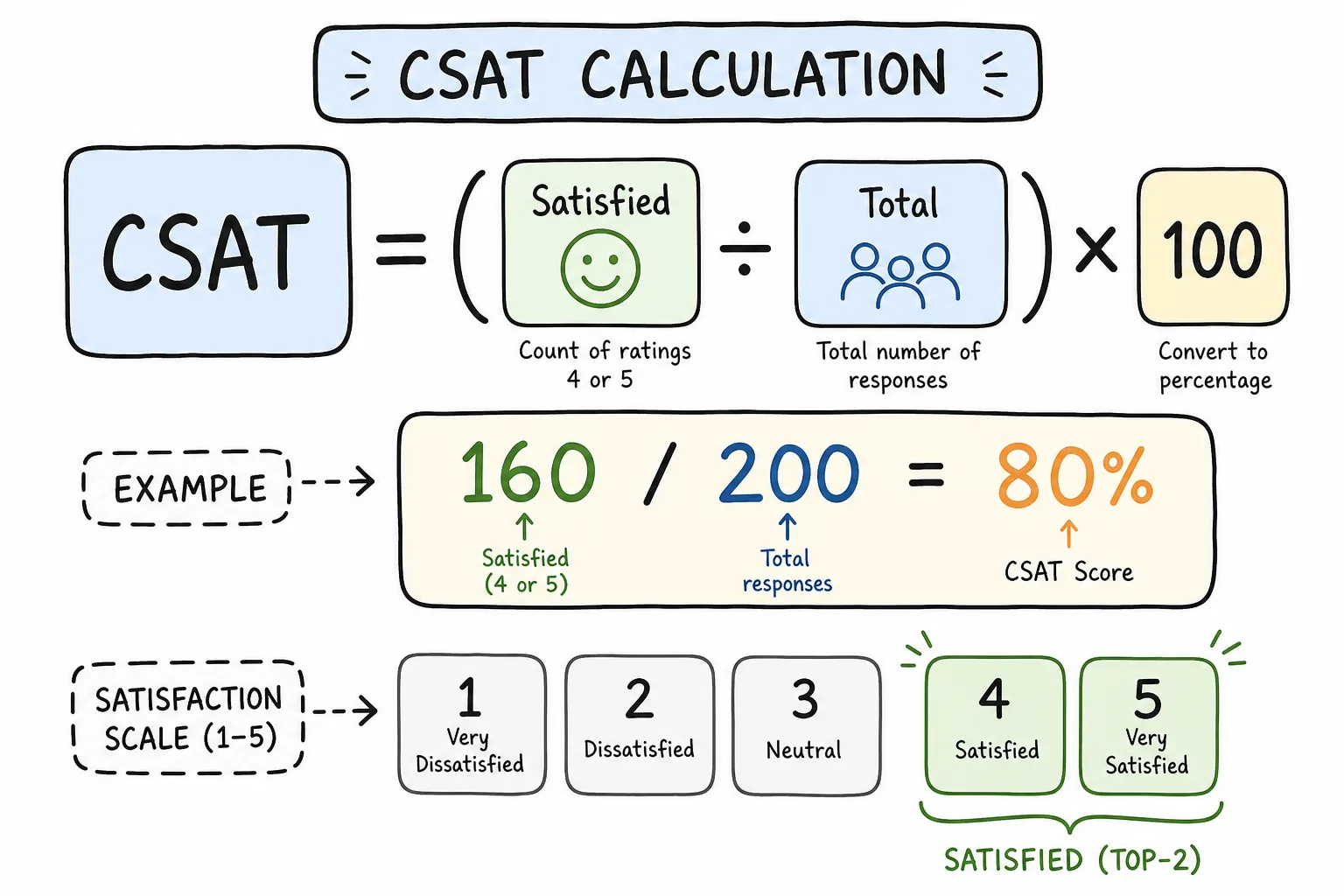
CSAT is a percentage of positive ratings, not the average star value alone.
The CSAT formula
CSAT = (satisfied responses ÷ total responses) × 100Example: 160 of 200 people rate 4 or 5 on a 1–5 scale → 80% CSAT.
You can also track average rating as a secondary metric, but the headline CSAT percentage is what most CX teams report. If you already have rating tallies, plug them into the CSAT calculator to get the percentage, average rating, and an optional industry reference check.
CSAT vs NPS vs CES
These three metrics answer different questions. Mixing them without a plan creates noise.
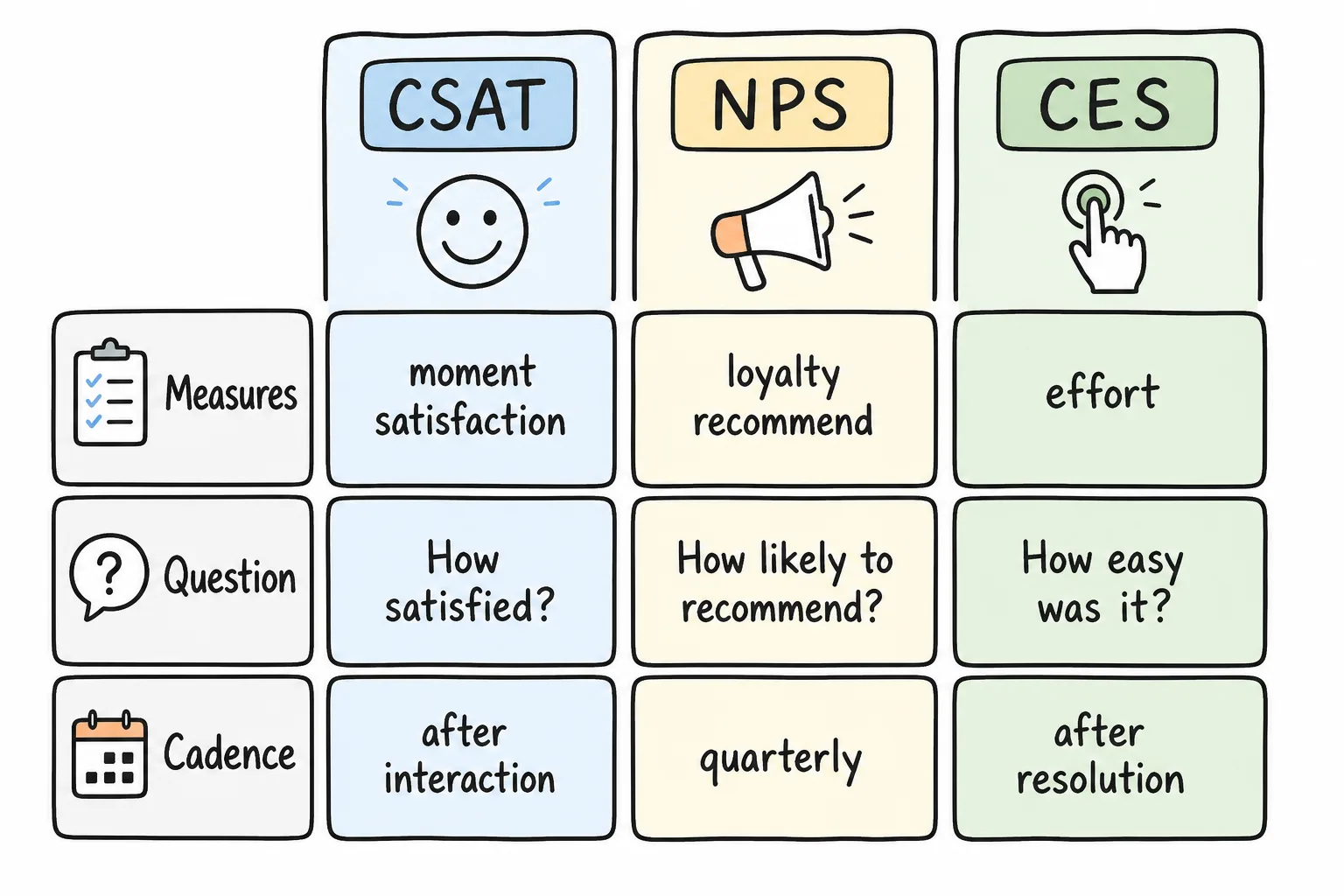
CSAT = moment. NPS = relationship. CES = friction.
| Metric | Core question | Scale | Best cadence |
|---|---|---|---|
| CSAT | How satisfied were you with this? | Usually 1–5 or 1–7 | After a specific interaction |
| NPS | How likely are you to recommend us? | 0–10 | Quarterly / lifecycle milestones |
| CES | How easy was it to get this done? | Often 1–7 agree/disagree | After resolution or self-service |
NPS (Net Promoter Score) is defined by the Net Promoter System as the share of promoters minus detractors on a 0–10 recommend question. See how Bain describes measuring NPS for the standard promoter / passive / detractor split. Calculate yours with the NPS calculator.
CES grew from research popularized in Harvard Business Review’s “Stop Trying to Delight Your Customers”, which argued that reducing effort often predicts loyalty better than chasing delight in service interactions.
Key takeaway: Use CSAT when you need a clean read on a moment. Use CES when friction is the hypothesis. Use NPS when you need a relationship loyalty signal.
Types of Customer Satisfaction Surveys
Transactional CSAT
Sent right after a defined event: ticket closed, order delivered, onboarding step finished, appointment completed.
Strength: High recall, clear ownership (this queue, this flow, this store).
Risk: Over-surveying people who contact you often.
Relationship CSAT
Asks about overall satisfaction with the brand, product, or account, usually on a monthly or quarterly cadence.
Strength: Broader pulse across the journey.
Risk: Vague answers if you do not add theme questions or segment by tenure and plan.
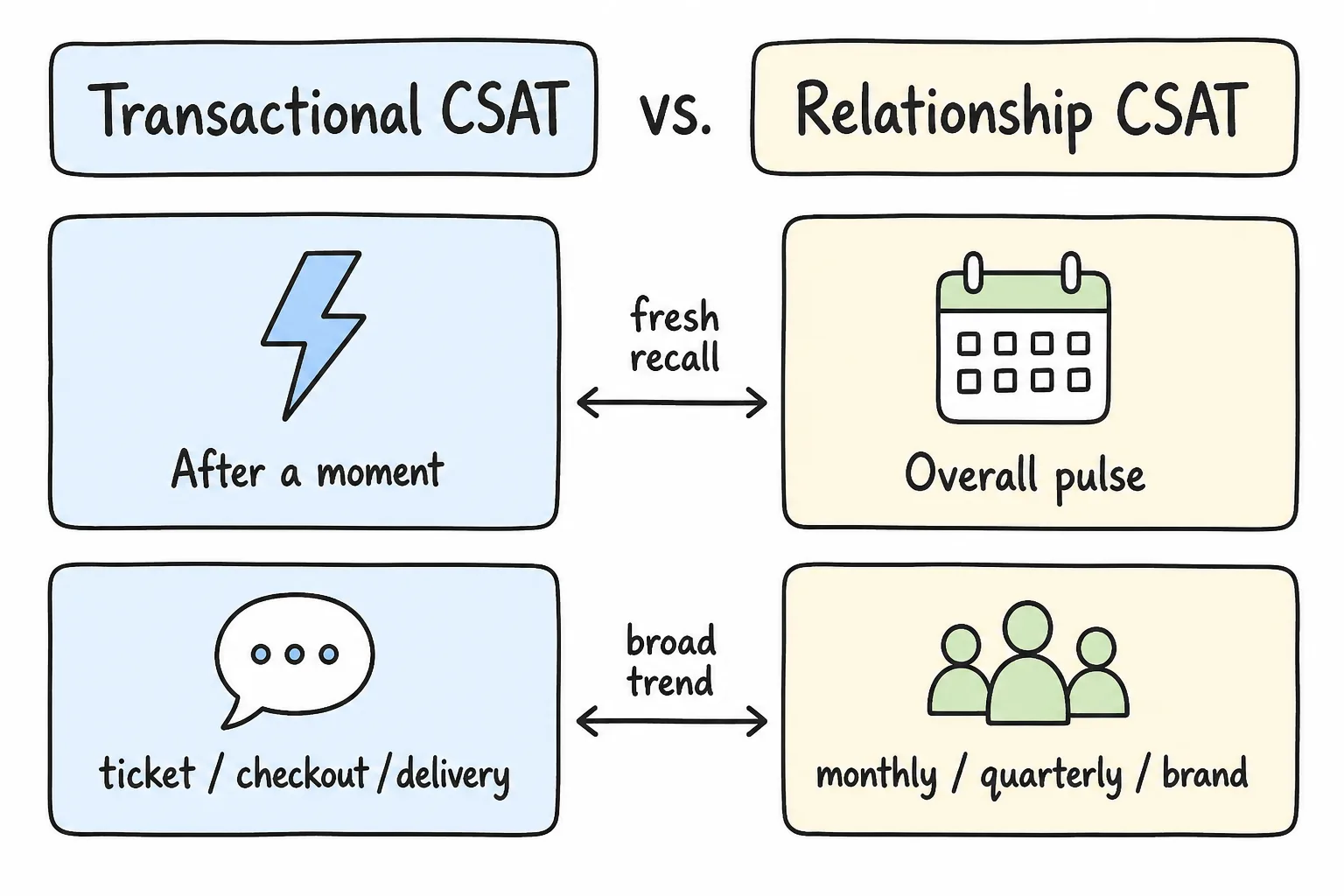
Match the survey type to the decision you need to make.
Common journey moments
| Moment | What to ask about | Watch for |
|---|---|---|
| Post-support | Resolution quality, agent clarity, wait | Sampling only ticket creators |
| Post-purchase | Product fit, delivery, returns ease | Shipping delays dominating the score |
| Onboarding | Clarity, time-to-value, setup help | Early enthusiasm bias |
| In-product feature | Usefulness after first real use | Interrupting mid-task |
| Event / in-person | Venue, staff, wait, overall visit | Incomplete scans if the form is long |
For in-person moments, a phone-first form behind a QR code often beats a paper card. See how to collect customer feedback with a QR code.
When to Use CSAT (and When Not To)
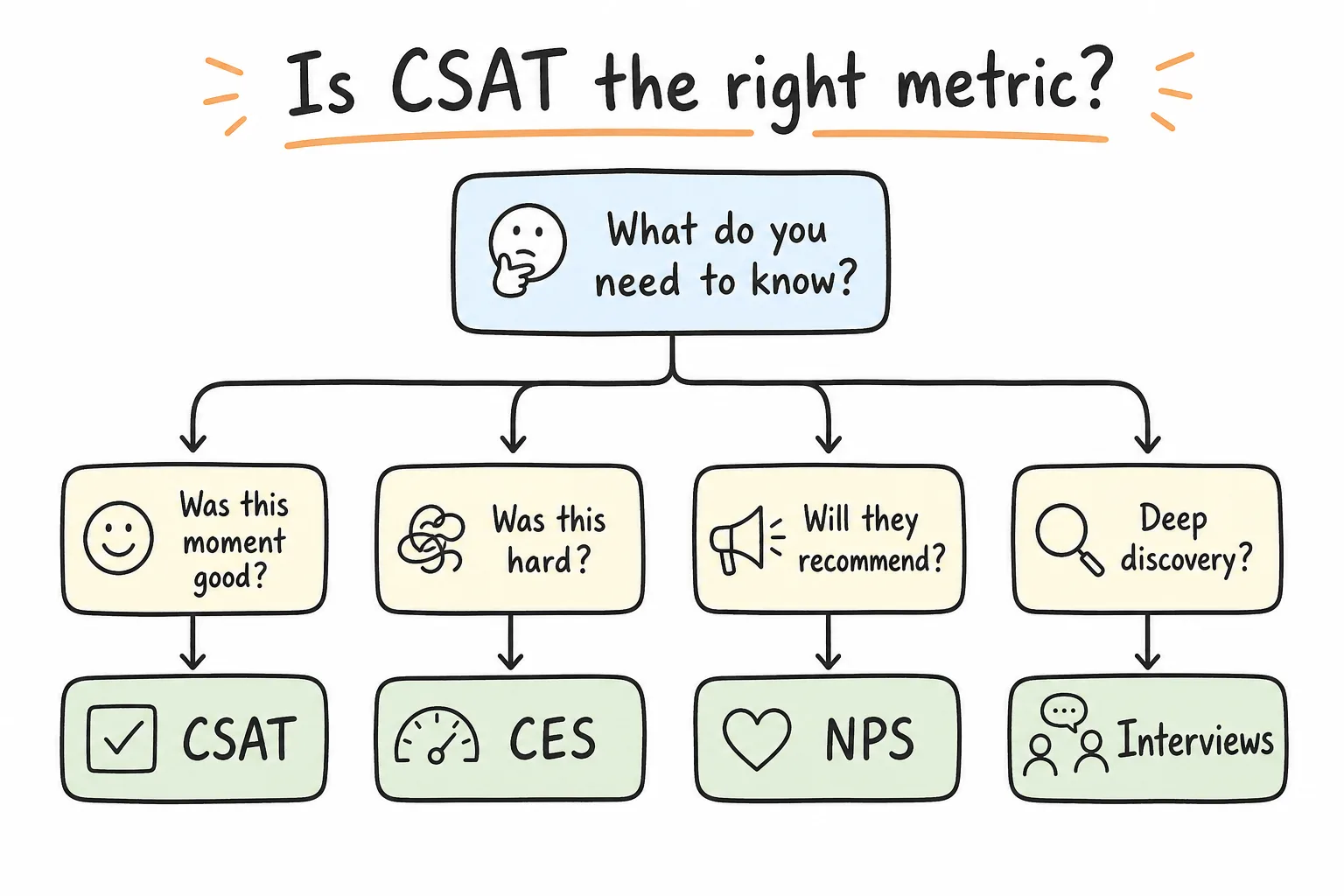
If you cannot name the decision the score will change, do not send the survey yet.
Use CSAT when
- You need a fast read on a specific touchpoint
- Owners can act within days (support, ops, product)
- The experience is still fresh in memory
- You will pair the score with a “why” and a follow-up path for low scores
Prefer another approach when
- You care more about loyalty and advocacy than a single interaction → NPS
- You suspect friction, not happiness, is the problem → CES
- You need deep discovery (jobs to be done, pricing research) → interviews or longer research studies
- Volume is too low for a stable percentage → wait, widen the window, or use qualitative outreach
- You already survey the same people weekly → consolidate; survey fatigue destroys signal
How to Create a Customer Satisfaction Survey
1. Write one primary question
Keep the object of the question precise:
- Weak: “How satisfied are you with us?”
- Stronger: “How satisfied were you with the support you received on this request?”
- Stronger: “How satisfied were you with your checkout experience today?”
2. Choose a scale and stick to it
Document:
- Scale length (5 vs 7)
- Which boxes count as satisfied
- Whether neutrals sit in the denominator (they should)
3. Add one diagnostic follow-up
Examples:
- “What is the main reason for your score?”
- “What could we improve?”
- Multiple choice themes: wait time, clarity, resolution, product quality, pricing, other
Open text after a low score is often more valuable than three extra rating questions.
4. Keep it short
Aim for under a minute on a phone. A reliable anatomy:
- CSAT rating
- One reason / theme
- Optional comment
- Optional “may we follow up?”
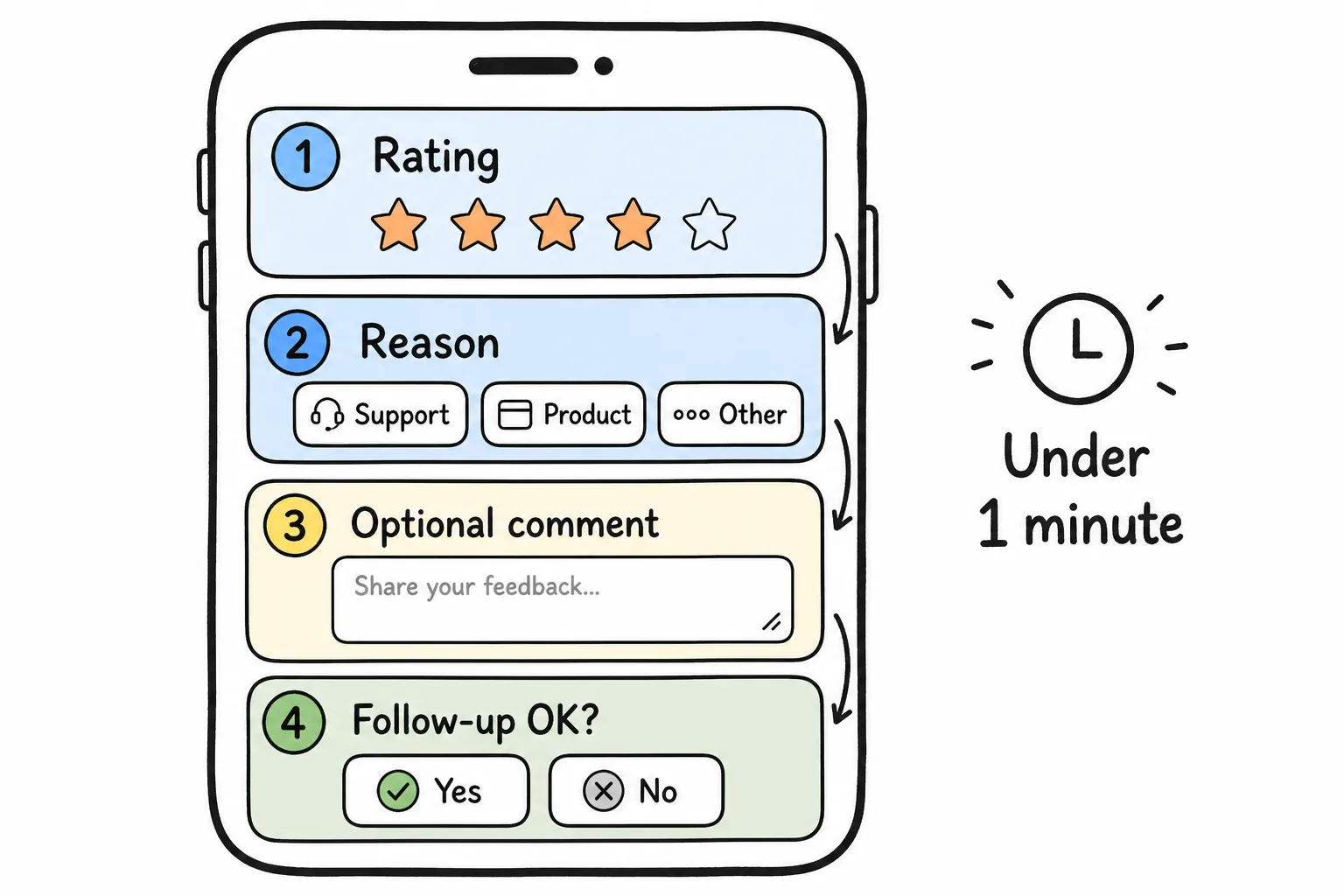
Fewer questions usually mean more completes and cleaner trends.
5. Design for mobile first
Large tap targets, no tiny radio grids, minimal typing, one question per screen if your tool supports it. If you build from a prompt, turn the prompt into a shareable form and test on a real phone before you launch.
Customer Satisfaction Survey Questions and Templates
Use these as starting points. Adapt nouns to your product and moment.
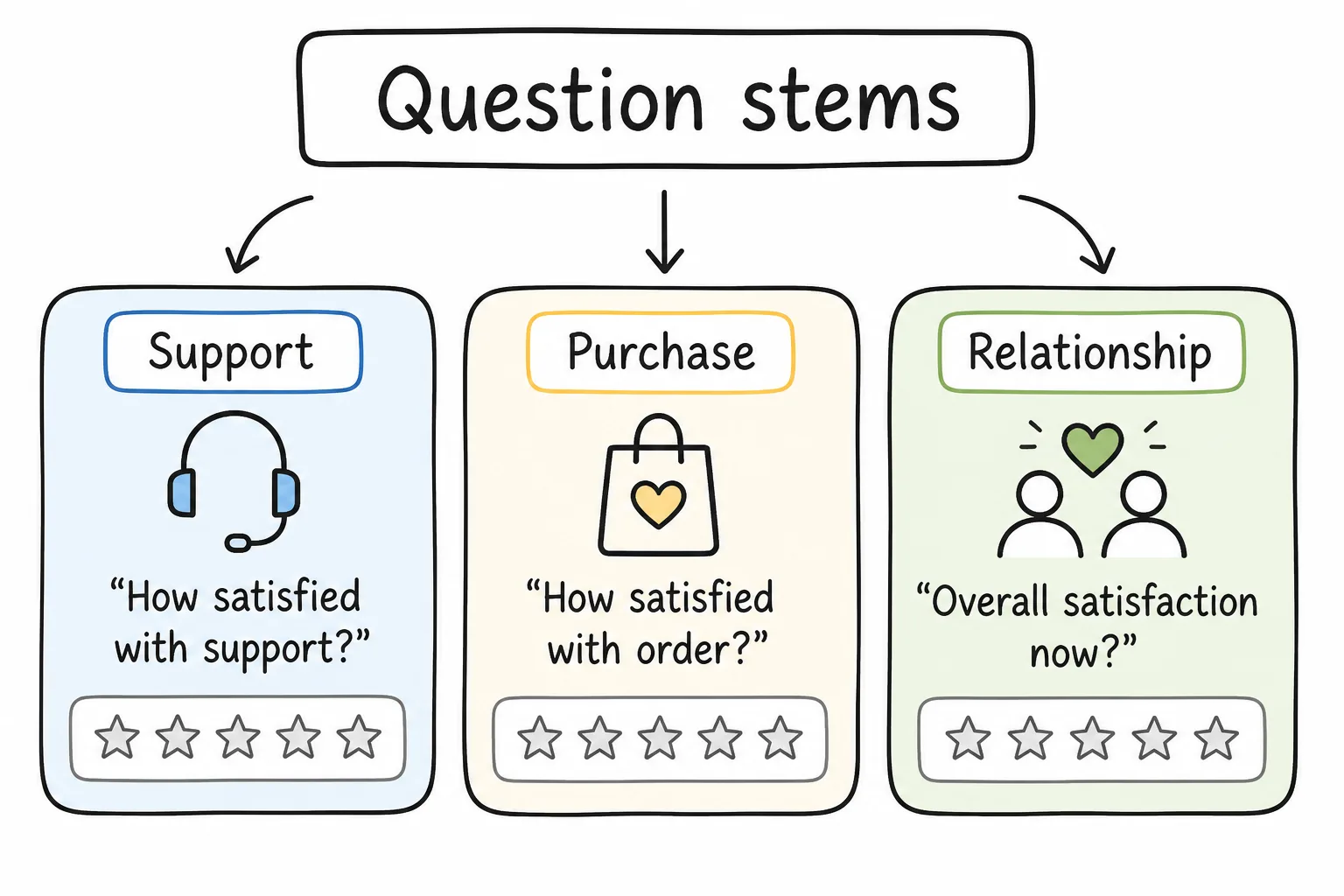
One precise rating plus one reason beats a long laundry list.
Core CSAT stems
- How satisfied were you with your overall experience today?
- How satisfied were you with the support you received on this request?
- How satisfied were you with [product / order / appointment]?
- How well did we meet your expectations for this interaction?
- Overall, how satisfied are you with [company / product] right now?
Support / service follow-ups
- Was your issue fully resolved?
- How clear was the guidance you received?
- How reasonable was the time it took to get help?
- What is the main reason for your score?
- What is one thing we should change next?
Product / purchase follow-ups
- How satisfied were you with product quality?
- How easy was checkout or setup?
- How satisfied were you with delivery or access timing?
- Did the product do what you expected?
- What almost stopped you from buying or finishing setup?
Relationship pulse extras (use sparingly)
- How satisfied are you with the value you receive for the price?
- How well does [product] fit your needs today?
- How easy is it to get help when you need it?
- How likely are you to continue using us over the next 6 months?
- What should we prioritize improving this quarter?
For a much larger bank organized by metric, use the customer service survey questions guide.
Mini templates
Post-support (3 questions)
- CSAT on support received
- Issue resolved? (Yes / Partially / No)
- What could we improve?
Post-purchase (4 questions)
- CSAT on purchase experience
- Product met expectations?
- Main friction theme (multiple choice)
- Optional comment
Quarterly relationship (5 questions max)
- Overall CSAT with brand/product
- Value for price
- Ease of getting help
- Top improvement theme
- Optional open comment
Channels and Timing
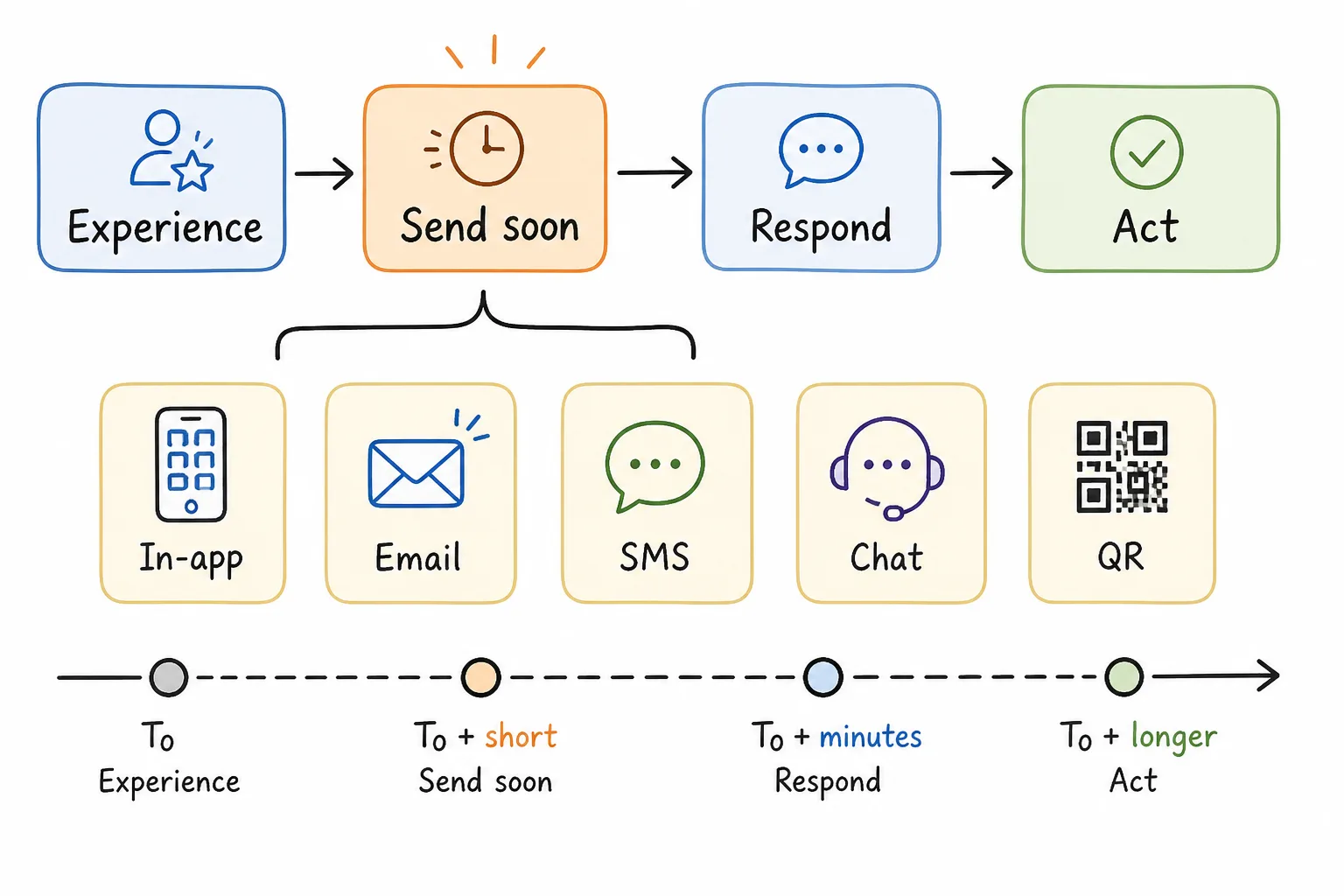
Send while memory is fresh, on the channel where the experience happened when you can.
| Channel | Best for | Watch-outs |
|---|---|---|
| In-app / web | Feature and workflow moments | Do not block a critical task |
| Receipts, resolutions, relationship pulses | Lower urgency; subject line matters | |
| SMS / messaging | Time-sensitive transactional asks | Keep extremely short; respect consent |
| Chat / ticket widget | Immediately after chat close | Avoid surveying unresolved threads |
| QR / kiosk / table tent | Stores, events, clinics, venues | Form length decides completion after scan |
| Phone | High-value accounts | Interviewer effects; use sparingly |
Timing rules that hold up in practice:
- Transactional: send as soon as the event is complete (minutes to a few hours, not days later)
- Delivery / visit: same day when possible
- Relationship: fixed cadence (monthly or quarterly), not after every click
- Reminders: one reminder max for most programs
Track response rate alongside the score. A rising CSAT on a collapsing response rate is not a win. Use the survey response rate calculator when you want a clean rate, and the confidence interval calculator when sample sizes are small.
What Is a Good CSAT Score?
There is no universal “good” number. Context beats slogans.
As a rough cross-industry guide many teams still use:
| CSAT % | Common reading |
|---|---|
| 85%+ | Strong / excellent for many service contexts |
| 75–84% | Solid; dig into themes and segments |
| 65–74% | Mixed; prioritize friction fixes |
| Below 65% | Urgent investigation |
Industry and channel matter. Banking and SaaS programs often run higher than telecom or utilities in published tables. Your own baseline, by channel and segment, is the real target. National indexes like ACSI are useful for macro context; they are not a substitute for your top-box CSAT definition.
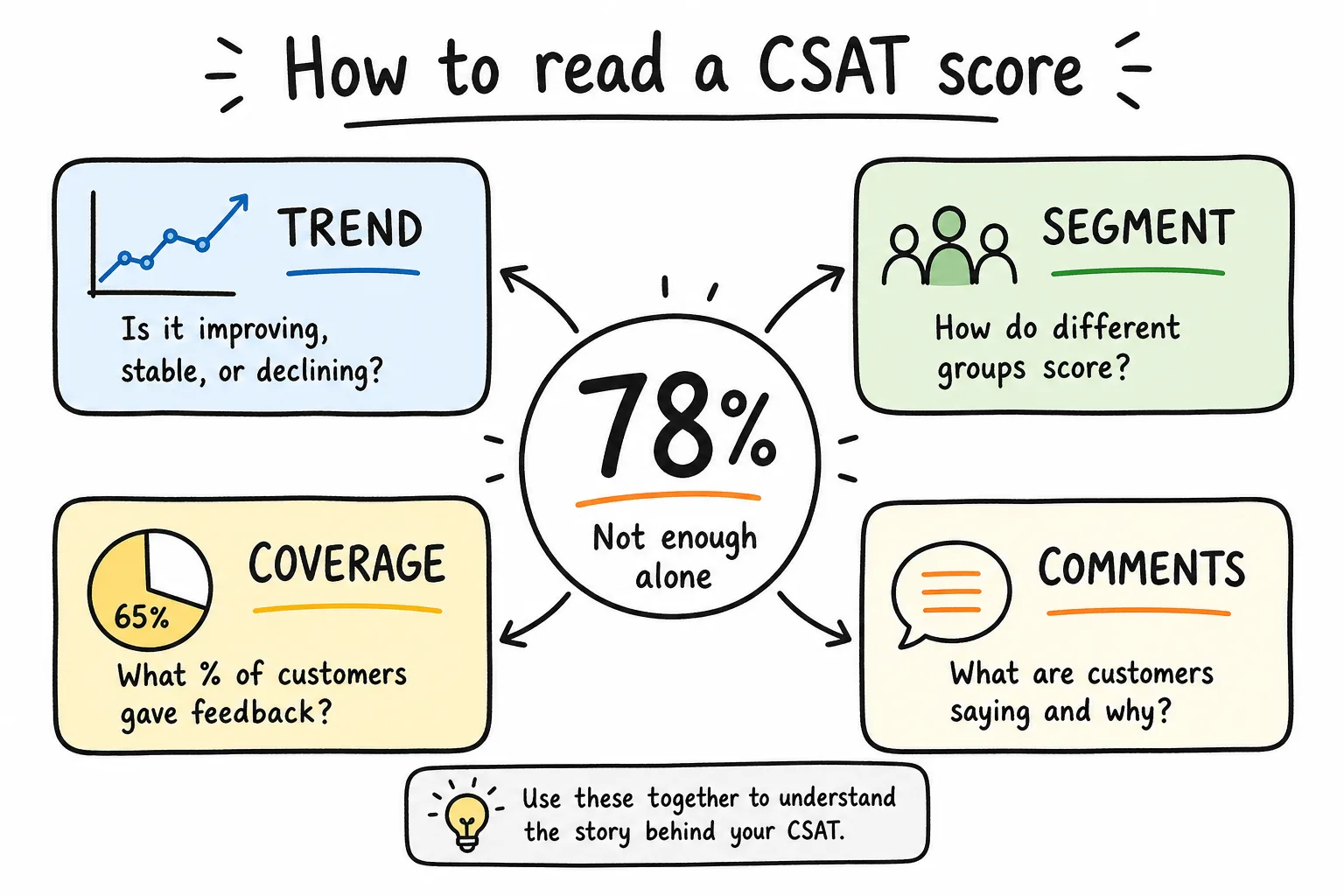
Read the trend and the comments, not a single week’s average in isolation.
How to read a score responsibly
- Trend over time on a stable definition
- Segment by channel, team, product, tenure, and issue type
- Coverage (who responded vs who was invited)
- Comments and themes behind lows and highs
- Operational couples (first response time, reopen rate, refund rate)
A 78% that is climbing with healthier response coverage can beat an 88% built from ten fans.
From Score to Action: Closing the Loop
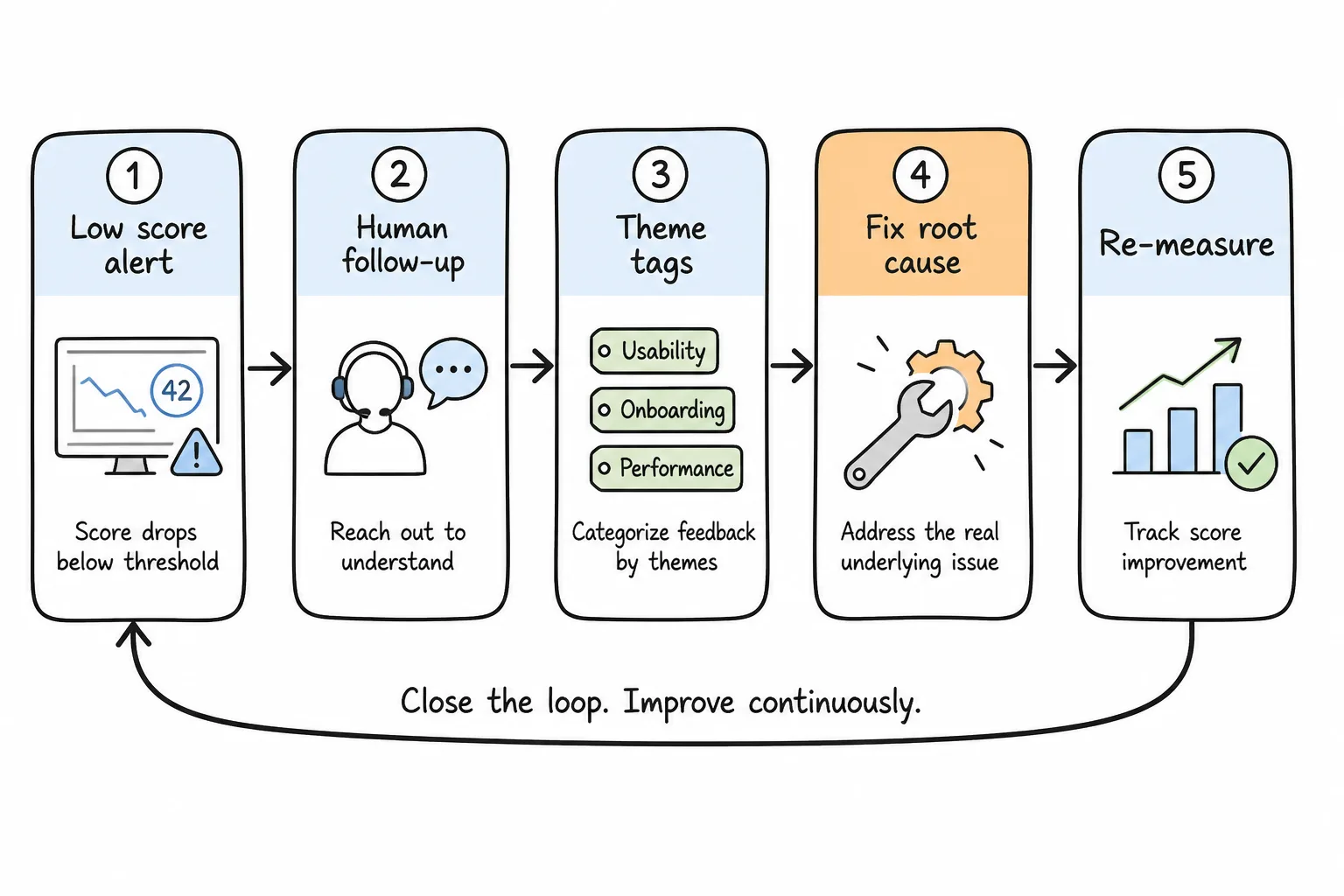
Unhappy respondents are a recovery opportunity, not just a red cell in a spreadsheet.
A survey without action teaches customers that feedback disappears.
Minimum closed-loop practice:
- Route low scores (for example 1–2 on a 5-point scale) to a human owner within one business day
- Tag themes weekly (wait, clarity, bugs, billing, delivery)
- Fix the highest-volume root causes first
- Tell customers when a fix ships when you can
- Re-measure the same touchpoint after the change
High scores deserve a lighter loop: thank-yous, testimonials (with permission), and notes on what to protect.
Best practice: Separate “alert follow-up” (individual recovery) from “system fix” (process or product change). Doing only alerts burns agents out. Doing only dashboards leaves customers hanging.
How to Improve Customer Satisfaction Survey Results
Improving the score and improving the survey are different jobs.
Improve the experience the survey measures
- Cut first response and resolution time where they drive lows
- Raise first-contact resolution; repeats destroy CSAT
- Clarify policies before customers hit support
- Fix the top three comment themes before launching a redesign
- Make self-service actually resolve the top intents
Improve the survey itself
- Shorten it
- Ask about one moment only
- Send sooner
- Survey on the same channel as the experience when possible
- Stop over-sampling power users
- Publish an internal “definition of satisfied” so teams argue less about math
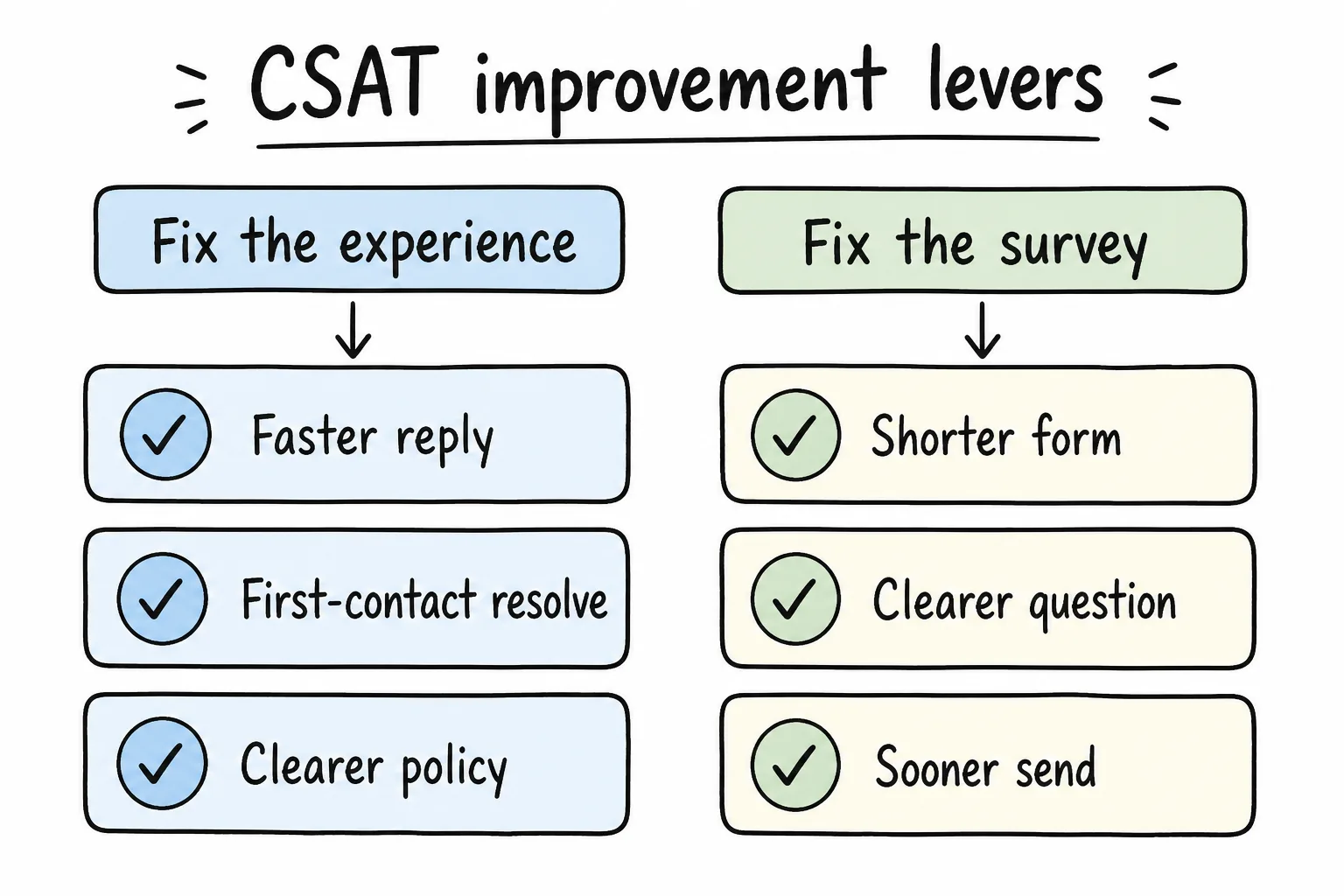
Most lasting CSAT gains come from removing friction, not from rewriting the thank-you page.
Common Mistakes
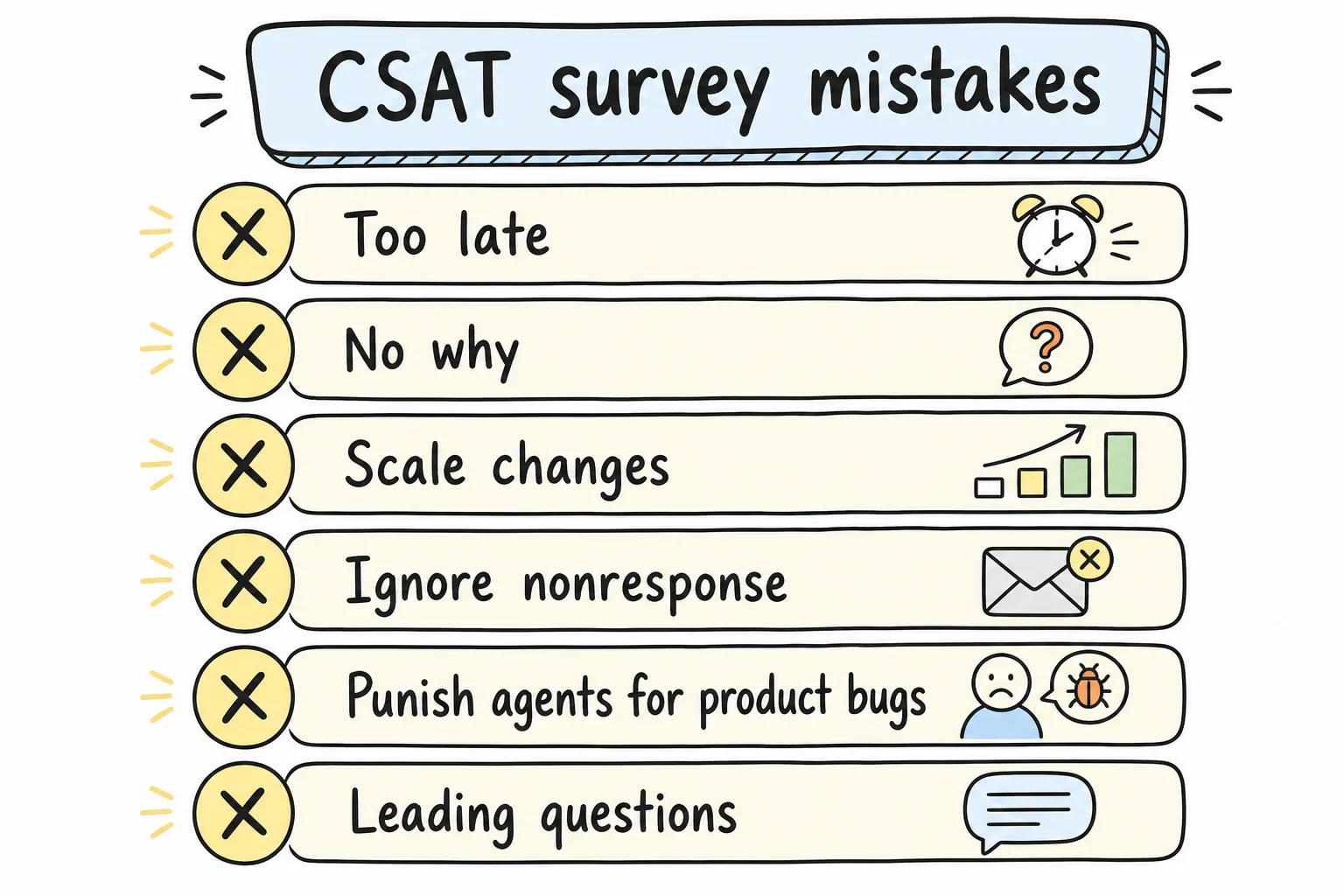
Most “CSAT is useless” complaints are process failures, not metric failures.
- Surveying too late so memory is fuzzy
- Asking five ratings and no “why”
- Changing the scale every quarter and still charting one line
- Ignoring nonresponse and celebrating a biased sample
- Treating CSAT as NPS (or the reverse)
- No owner for low scores
- Punishing agents for structural product failures
- Leading questions (“How amazing was our world-class support today?”)
- Double-barreled items (“How satisfied were you with speed and accuracy?”)
- Launching on desktop-only layouts for phone respondents
A Practical 2026 CSAT Program Checklist
- One primary CSAT question with a documented scale and top-box rule
- One diagnostic follow-up on every transactional survey
- Clear trigger events (and a do-not-survey list)
- Mobile-tested form and invitation copy
- Response-rate tracking beside the score
- Low-score routing with an SLA
- Weekly theme review with product and support owners
- Quarterly relationship pulse (if needed), not a second transactional blast
- Stable definitions for at least two consecutive quarters before big target changes
Frequently Asked Questions
What is a customer satisfaction survey?
It is a short questionnaire that asks how satisfied someone was with a product, service, or interaction. Most versions lead with a CSAT rating and add a brief follow-up so you know what to fix.
What does CSAT stand for?
CSAT stands for Customer Satisfaction Score. It is usually reported as the percentage of respondents who chose a positive rating on your scale.
How do you calculate CSAT?
Divide satisfied responses by total responses, then multiply by 100. On a 1–5 scale, satisfied usually means ratings of 4 and 5.
What is a good CSAT score in 2026?
Many teams treat roughly 75–85% as solid and 85%+ as strong, but industry, channel, and your own baseline matter more. Macro indexes such as ACSI provide economy-wide context; they are not a direct substitute for your top-box percentage.
How many questions should a CSAT survey include?
Prefer one to four questions for transactional surveys. If people need more than about a minute after a casual invite or QR scan, completion usually falls.
Should I use a 5-point or 7-point scale?
Use 5-point for most day-to-day CSAT. Use 7-point when you need finer sensitivity and can keep the definition of “satisfied” consistent over time.
CSAT vs NPS: which should I use?
Use CSAT for a specific interaction. Use NPS for overall willingness to recommend. Many mature programs run both on different cadences rather than forcing one metric to do both jobs.
When should I send a customer satisfaction survey?
As soon as the experience is complete while memory is fresh: after ticket resolution, delivery, checkout, onboarding milestones, or an in-person visit.
How do I improve low CSAT?
Follow up with unhappy respondents quickly, tag recurring themes, fix the highest-volume causes, and re-measure the same touchpoint. Coaching helps when the issue is agent skill; process or product work is required when themes are structural.
Are customer satisfaction surveys still effective?
Yes, when they are short, well timed, and tied to owners who act. They are weak when they are long, late, disconnected from operations, or treated as a PR scoreboard.
How many responses do I need?
Directional reads can start with a few dozen replies. For steadier tracking, many teams aim for 100+ completes per wave, more when comparing segments. Pair small samples with a confidence interval.
Can I run CSAT offline or in person?
Yes. Use tablets, kiosks, or a QR code that opens a mobile form. Keep the form short enough that a twelve-second scan is not followed by a five-minute questionnaire.
Conclusion
A customer satisfaction survey works when three pieces stay aligned: a precise question about a real moment, a stable CSAT definition you can trend, and a closed loop that turns low scores into fixes.
In 2026 the bar is not another dashboard tile. It is a program that respects customer time, resists survey fatigue, and connects comments to owners. Start with one transactional survey, one follow-up question, and a weekly theme review. Expand only after that loop is reliable.
When you are ready to ship, keep the form phone-first and shareable. Formms can turn a short prompt into a live survey with a link and QR if you want that path; the questions and follow-up discipline still matter more than the generator. For the score math itself, use the CSAT calculator, and for question ideas beyond this guide, see 100 customer service survey questions.